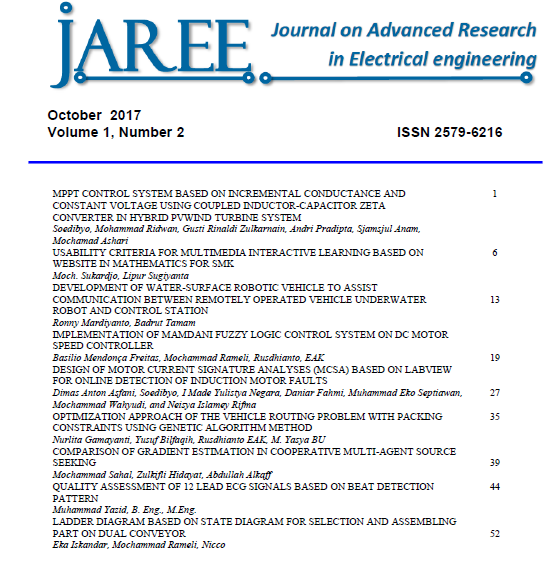
MPPT Control System Based on Incremental Conductance and Constant Voltage using Coupled Inductor-Capacitor Zeta Converter in hybrid PV-Wind Turbine System
Bilah Samping Artikel
Isi Artikel Utama
Abstrak
This paper proposes a method of maximum power point tracking control using Incremental Conductance employed in hybrid photovoltaic-wind turbine for DC micro-grid system. The rapid growth of renewable energy using photovoltaic (PV) and wind turbine due to low operational cost and easy to implementation. Improvement of the efficiency of PV and wind turbine based on incremental conductance is the solution to get maximum power in PV and Wind Turbine. The proposed method uses variable step to achieve maximum power with high speed tracking, high efficiency and low steady state error calculation. The performance of the MPPT technique has been applied in dc-dc boost converter. Moreover, Zeta Converter using Coupled Inductor-Capacitor is added for maintain constant voltage in passive load. This high gain converter can reach 311 Volt DC with 1000 W output power and high efficiency up to 90%. The effectiveness of proposed method is implemented in two hybrid system using PV and wind turbine source.
Keywords: incremental conductance technique; maximum power point tracking; Zeta Converter using Coupled Inductor-Capacitor.
Rincian Artikel
Copyright
Submission of a manuscript implies that the submitted work has not been published before (except as part of a thesis or report, or abstract); that it is not under consideration for publication elsewhere; that its publication has been approved by all co-authors. If and when the manuscript is accepted for publication, the author(s) still hold the copyright and retain publishing rights without restrictions. Authors or others are allowed to multiply article as long as not for commercial purposes. For the new invention, authors are suggested to manage its patent before published. The license type is CC-BY-NC 4.0.
Disclaimer
No responsibility is assumed by publisher and co-publishers, nor by the editors for any injury and/or damage to persons or property as a result of any actual or alleged libelous statements, infringement of intellectual property or privacy rights, or products liability, whether resulting from negligence or otherwise, or from any use or operation of any ideas, instructions, procedures, products or methods contained in the material therein.
Referensi
Gonzalez A,RibaJR, RiusA,PuigR.Optimal sizing of a hybrid grid-connected photovoltaic and windpower. Syst Appl Energy 2015;154:752–62.
TeyKS, MekhilefS. Modified incremental conductance MPPT algorithm to mitigate in accurate responses under fast-changing solar irradiation level.Sol Energy, 101;2014.p.333–42.
Kamarzaman NA, TanCW. A comprehensive review of maximum power point tracking algorithms for photovoltaic systems. Renew Sustain Energy Rev 2014;37:585–98.
M.Ahmed Emad M. Shoyama. Stability Study of Variable Step Size Incremental Conductance/Impedance MPPT for PV systems.In : Proceeding soft 8th International Conference on Power Electronics-ECCE Asia.The Shilla Jeju,Korea;2011.
PandeyA, DasguptaN, Mukerjee AK.High performance algorithms for drift avoidance and fast tracking in solar MPPT system.IEEE Trans Energy Convers 2008;23:681–9.
T. Esram and P. L. Chapman, "Comparison of photo voltaic array maximum power point tracking techniques," IEEE Transactions on Energy Conversion, vol. 22, no. 2, pp. 439-449, Jun. 2007.
Gilbert m. Masters, "Renewable and Efficient Electric Power Systems", A John Wiley & Sons, Publication
Shih-Ming Chen, Tsorng-Juu Liang, Lung-Sheng Yang, Jiann-Fuh Chen, “A Boost Converter With Capacitor Multiplier and Coupled Inductor for AC Module Applications”, IEEE Transaction on Industrial Electronics, Vol. 60, No. 4, April 2013
Kuo Nan Yu, Chih Kang Liao”Applying novel fractional order incremental conductance algorithm to design and study the maximum power tracking of small wind power systems” Journal of Applied Research and Technology 13 (2015) 238-244.April 2015
Abdelhamid Loukriz, Mourad Haddadi, Sabir Messalti Simulation and experimental design of a new advanced variable step size Incremental Conductance MPPT algorithm for PV systems. ISA Transactions62(2016)30–38. August 2016