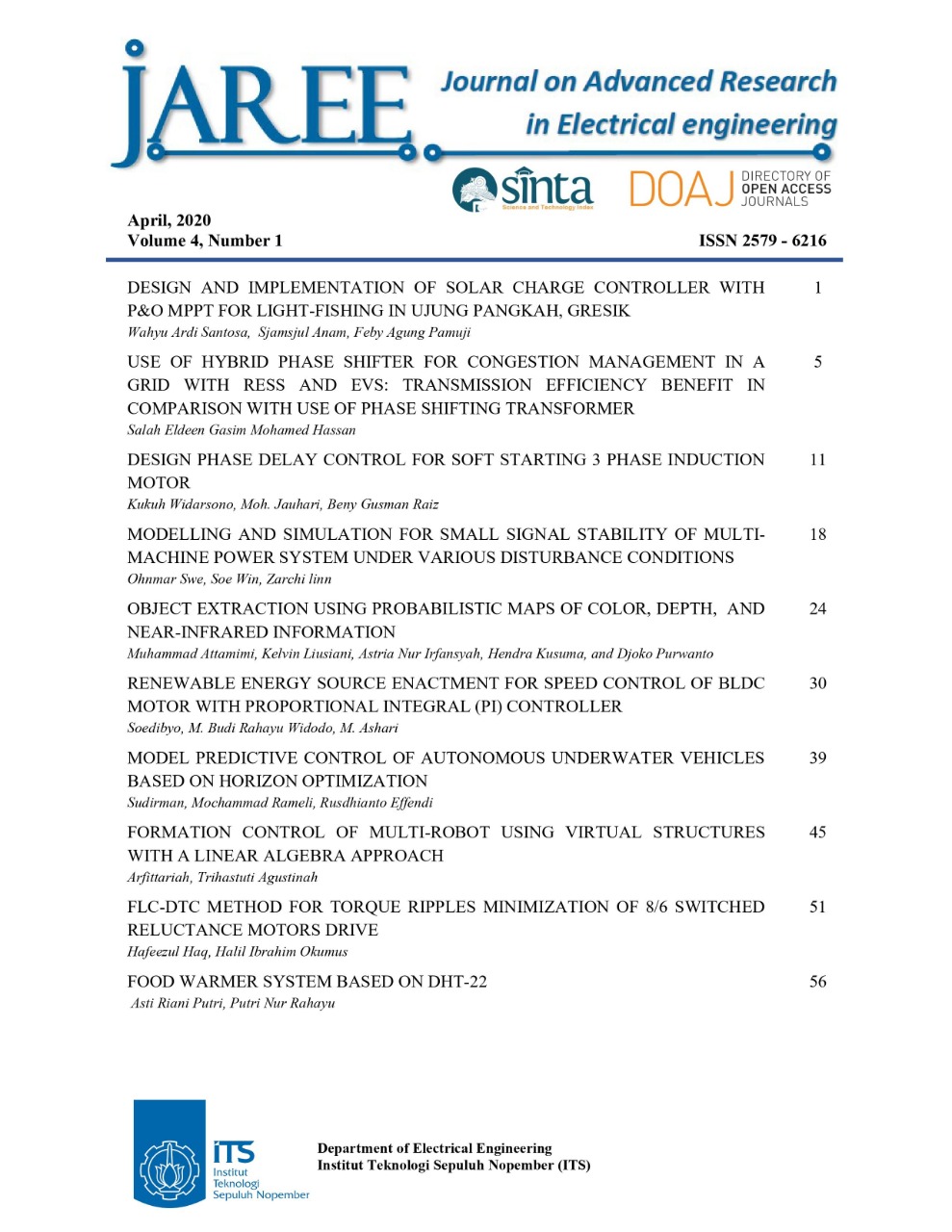
Modelling and Simulation for Small Signal Stability of Multi-machine Power System under Various Disturbance Conditions
Article Sidebar
Main Article Content
Abstract
This paper presents the small signal stability of multi-machine power system over the 58-Bus, 26-Machine, Yangon Distribution Network and is validated with MATLAB software under various disturbance conditions. Time-domain solution analysis is employed to determine the small signal dynamic behavior of test system. Transtability model is used to perform time-domain simulation in SIMULINK. The simulation is carried out for normal condition, reference voltage of regulator (Vref) disturbance, mechanical torque (Tm)disturbance and network (fault) disturbance and the conditions of change in center of inertia for rotor angle (delta COI), slip for center of inertia (slip COI), field current and mechanical torque are observed. According to the simulation results, perturbation of Vref shows only instability on the system. But ramping of Tm and network disturbance can cause large disturbance on the system and unstable conditions can be observed.
Keywords: load flow, multi-machine power system, small signal stability analysis,
system disturbances, time domain simulation.
Article Details
Copyright
Submission of a manuscript implies that the submitted work has not been published before (except as part of a thesis or report, or abstract); that it is not under consideration for publication elsewhere; that its publication has been approved by all co-authors. If and when the manuscript is accepted for publication, the author(s) still hold the copyright and retain publishing rights without restrictions. Authors or others are allowed to multiply article as long as not for commercial purposes. For the new invention, authors are suggested to manage its patent before published. The license type is CC-BY-NC 4.0.
Disclaimer
No responsibility is assumed by publisher and co-publishers, nor by the editors for any injury and/or damage to persons or property as a result of any actual or alleged libelous statements, infringement of intellectual property or privacy rights, or products liability, whether resulting from negligence or otherwise, or from any use or operation of any ideas, instructions, procedures, products or methods contained in the material therein.
References
K.R. Padiyar, Power System Dynamics - Stability and Control, BS Publications, Hyderabad, India, 2002.
P. Kundur, Power System Stability and Control, McGraw-Hill Inc., New York, 1994.
Nelson Martins, Efficient Eigenvalue and Frequency Response Methods Applied to Power System Small-Signal Stability Studies," IEEE Transactions on Power Systems, Vol. PWRS-1, No. 1, pp 217-224, February, 1986.
P.W. Sauer and M.A. Pai, Power System Dynamics and Stability, Prentice Hall,Upper Saddle River, New Jersy, 1998.
IEEE Recommended Practice for Excitation Systems Model for Power System Stability Studies, IEEE Standard 421.5-1992.