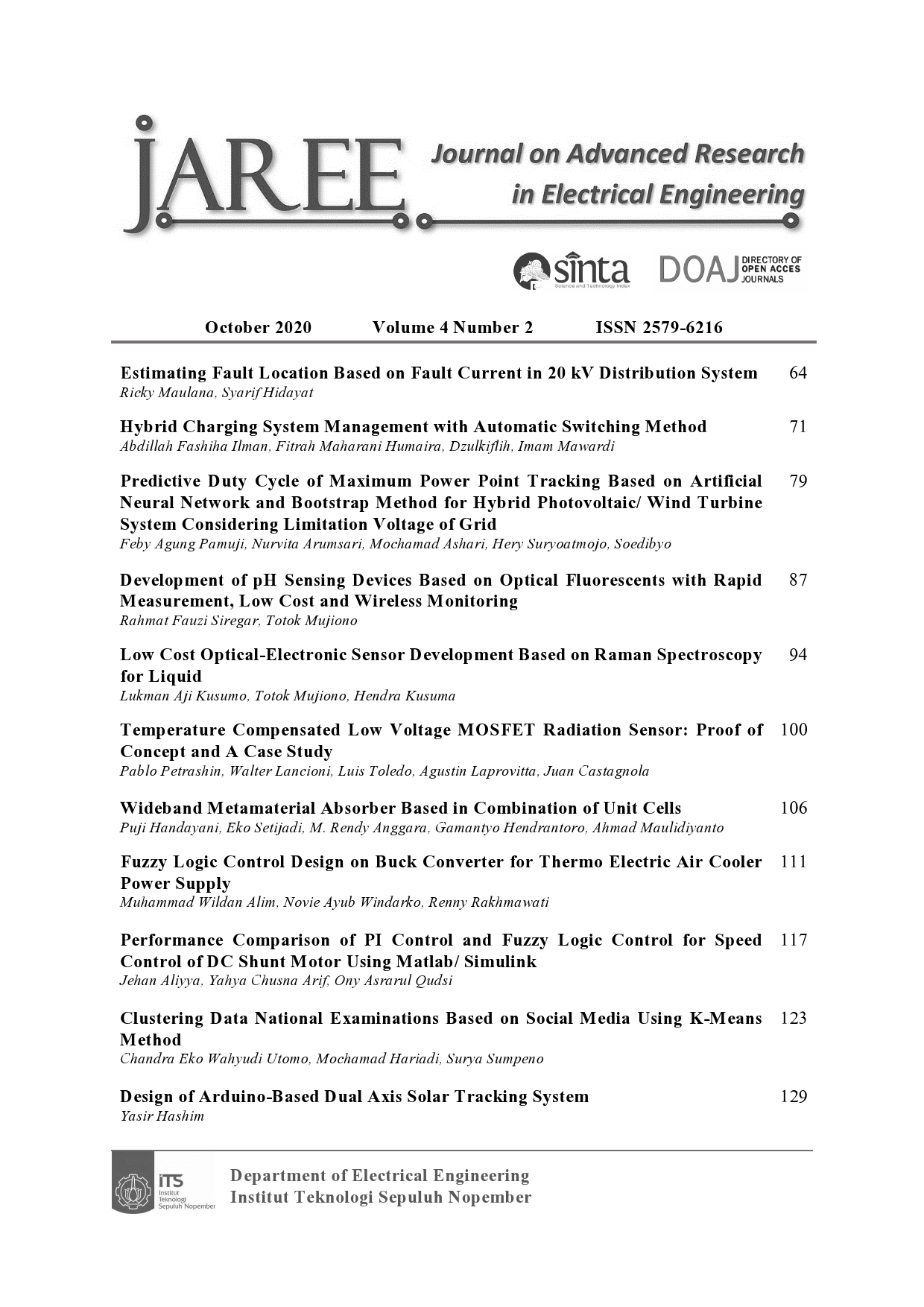
Estimating Fault Location Based on Fault Current in 20 kV Distribution System
Article Sidebar
Main Article Content
Abstract
The growth of the electric power system is currently taking place rapidly, causing an increase in the number and length of line to provide consumer services. In the line, there are often fault caused by lightning, storms, breakdown insulation, and short circuit caused by birds and other objects. Detection and location determination will speed up the repair process and can avoid more severe damage. Most studies refer to the fault location on the transmission line. But lately the determination of fault location in distribution system has begun to become a concern of researchers for the improvement of the quality of electricity services to consumers. This study discusses the determination of fault locations based on fault currents and the types of disturbances using data from the assumed distribution system model. The estimated fault location by ignoring the fault resistance has the largest error obtained 0.74% and estimated fault location by including fault resistance will cause a very large error, but the error can be reduced by changing the algorithm of the fault resistance assumption. The result for to ground fault error has reached 1.238% and double line to ground error has reached 88.167%.
Keywords: distribution system, fault current, fault location, fault resistance.
Article Details
Copyright
Submission of a manuscript implies that the submitted work has not been published before (except as part of a thesis or report, or abstract); that it is not under consideration for publication elsewhere; that its publication has been approved by all co-authors. If and when the manuscript is accepted for publication, the author(s) still hold the copyright and retain publishing rights without restrictions. Authors or others are allowed to multiply article as long as not for commercial purposes. For the new invention, authors are suggested to manage its patent before published. The license type is CC-BY-NC 4.0.
Disclaimer
No responsibility is assumed by publisher and co-publishers, nor by the editors for any injury and/or damage to persons or property as a result of any actual or alleged libelous statements, infringement of intellectual property or privacy rights, or products liability, whether resulting from negligence or otherwise, or from any use or operation of any ideas, instructions, procedures, products or methods contained in the material therein.
References
S. M. Brahma, “Fault location in power distribution system with penetration of distributed generation,” IEEE Trans. Power Deliv., vol. 26, no. 3, pp. 1545–1553, 2011.
. S. and R. Maulana, “Program Aliran Daya Untuk Analisis Sistem Distribusi Dengan Penambahan Photovoltaic Model,” J. Nas. Tek. Elektro, vol. 1, no. 1, pp. 1–10, Oct. 2012.
M. S. Sachdev, R. Das, and T. S. Sidhu, “Determining locations of faults in distribution systems,” in IEE Conference Publication, 1997, no. 434, pp. 188–191.
V. De Andrade and E. Sorrentino, “Typical expected values of the fault resistance in power systems,” in 2010 IEEE/PES Transmission and Distribution Conference and Exposition: Latin America, T and D-LA 2010, 2011, pp. 602–609.
W. D. Stevensons and I. Kemal, Analisis Sistem Tenaga Listrik, 4th ed. Jakarta: Erlangga, 1994.
H. Saadat, Power System Analysis. New York: McGraw-Hill, 1993.
“Chapter 8: Unsymmetrical Faults.” [Online]. Available: https://nptel.ac.in/content/storage2/courses/108104051/ui/Course_home-8.htm.
J. H. Teng, “Unsymmetrical short-circuit fault analysis for weakly meshed distribution systems,” IEEE Trans. Power Syst., vol. 25, no. 1, pp. 96–105, 2010.
S. Hänninen, “Single phase earth faults in high impedance grounded networks Characteristics, indication and location,” VTT Publ., no. 453, pp. 2–78, 2001.