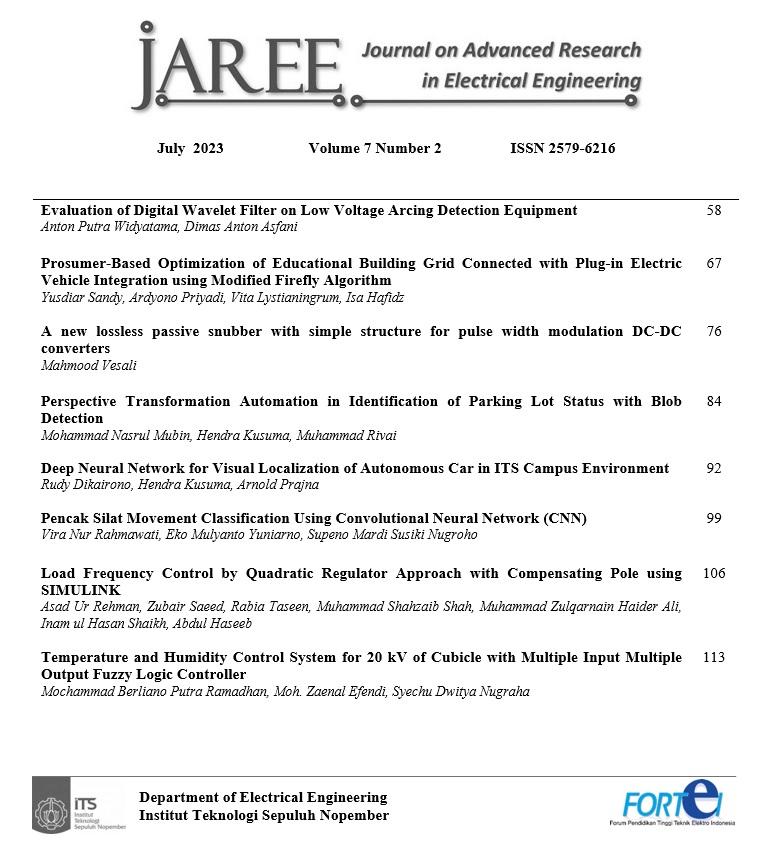
Temperature and Humidity Control System for 20 kV of Cubicle with Multiple Input Multiple Output Fuzzy Logic Controller
Article Sidebar
Main Article Content
Abstract
Cubicle 20 kV is a crucial electrical equipment in the 20 kV power distribution system. Often, cubicle issues arise due to excessively low or high temperatures and humidity, which can lead to the presence of water spots and corrosion on the components inside the 20 kV cubicle. One of the efforts to maintain the reliability of this 20 kV cubicle is to ensure that the temperature and humidity inside the cubicle remain within their operational limits. To achieve this, a system is needed to control the temperature and humidity in the 20 kV cubicle. The system can monitor and control the temperature and humidity inside the cubicle by adjusting the activation angle of the exhaust fan and heater. Control is achieved using a multiple-input, multiple-output fuzzy logic controller. The main components of this system are the STM32 microcontroller, DHT22 sensor, and ESP8266 module for monitoring temperature and humidity via a website. System has successfully controlled temperature and humidity d with a set point value of 35 °C and humidity of 60% RH. This implementation of fuzzy multiple input multiple outputs has performed well and resulted in only a small error of 0.55% for temperature and 1.05% for humidity.With the presence of this device, the temperature and humidity in the cubicle 20 kV can be controlled, and it enables the PLN operator to easily monitor and maintain the cubicle 20 kV.
Article Details
Copyright
Submission of a manuscript implies that the submitted work has not been published before (except as part of a thesis or report, or abstract); that it is not under consideration for publication elsewhere; that its publication has been approved by all co-authors. If and when the manuscript is accepted for publication, the author(s) still hold the copyright and retain publishing rights without restrictions. Authors or others are allowed to multiply article as long as not for commercial purposes. For the new invention, authors are suggested to manage its patent before published. The license type is CC-BY-NC 4.0.
Disclaimer
No responsibility is assumed by publisher and co-publishers, nor by the editors for any injury and/or damage to persons or property as a result of any actual or alleged libelous statements, infringement of intellectual property or privacy rights, or products liability, whether resulting from negligence or otherwise, or from any use or operation of any ideas, instructions, procedures, products or methods contained in the material therein.
References
A. Azam, M. Rafiq, M. Shafique, H. Zhang, M. Ateeq, and J. Yuan, “Analyzing the relationship between economic growth and electricity consumption from renewable and non-renewable sources: Fresh evidence from newly industrialized countries,” Sustain. Energy Technol. Assessments, vol. 44, no. September 2020, p. 100991, 2021, doi: 10.1016/j.seta.2021.100991.
T. Lorde, K. Waithe, and B. Francis, “The importance of electrical energy for economic growth in Barbados,” Energy Econ., vol. 32, no. 6, pp. 1411–1420, 2010, doi: 10.1016/j.eneco.2010.05.011.
N. A. Salim, J. Jasni, and M. M. Othman, “Reliability assessment by sensitivity analysis due to electrical power sequential tripping for energy sustainability,” Int. J. Electr. Power Energy Syst., vol. 126, no. PA, p. 106582, 2021, doi: 10.1016/j.ijepes.2020.106582.
J. R. Riba, J. Martínez, M. Moreno-Eguilaz, and F. Capelli, “Characterizing the temperature dependence of the contact resistance in substation connectors,” Sensors Actuators, A Phys., vol. 327, 2021, doi: 10.1016/j.sna.2021.112732.
F. Capelli, J. R. Riba, and J. Sanllehí, “Finite element analysis to predict temperature rise tests in high-capacity substation connectors,” IET Gener. Transm. Distrib., vol. 11, no. 9, pp. 2283–2291, 2017, doi: 10.1049/iet-gtd.2016.1717.
J. R. Riba, A. G. Mancini, C. Abomailek, and F. Capelli, “A 3D-FEM-based model to predict the electrical constriction resistance of compressed contacts,” Meas. J. Int. Meas. Confed., vol. 114, pp. 44–50, 2018, doi: 10.1016/j.measurement.2017.09.003.
A. Carsimamovic, A. Mujezinovic, S. Carsimamovic, Z. Bajramovic, M. Kosarac, and K. Stankovic, “Calculation of the corona onset voltage gradient under variable atmospheric correction factors,” Proc. - EUROCON 2015, pp. 1–5, 2015, doi: 10.1109/EUROCON.2015.7313697.
A. Carsimamovic, A. Mujezinovic, S. Carsimamovic, Z. Bajramovic, M. Kosarac, and K. Stankovic, “Analyzing of AC Corona Discharge Parameters of Atmospheric Air,” Procedia Comput. Sci., vol. 83, no. Seit, pp. 766–773, 2016, doi: 10.1016/j.procs.2016.04.165.
Y. Liu et al., “Corona onset gradient of the bundle conductor on AC power lines under sand and dust weather condition at 2,200 m altitude,” J. Electrostat., vol. 95, no. July, pp. 32–41, 2018, doi: 10.1016/j.elstat.2018.08.004.
L. Yunpeng et al., “Corona loss of the bundle conductors on EHV/UHV AC power lines under sandy and dusty conditions in high-altitude areas,” J. Electrostat., vol. 107, no. 619, p. 103476, 2020, doi: 10.1016/j.elstat.2020.103476.
E. Franceschi, M. Giorgi, G. Luciano, D. Palazzi, and E. Piccardi, “Archaeometallurgical characterisation of two small copper-based statues from the Cividale Museum (Friuli, Italy),” J. Cult. Herit., vol. 5, no. 2, pp. 205–211, 2004, doi: 10.1016/j.culher.2003.07.004.
A. Fateh, M. Aliofkhazraei, and A. R. Rezvanian, “Review of corrosive environments for copper and its corrosion inhibitors,” Arab. J. Chem., vol. 13, no. 1, pp. 481–544, 2020, doi: 10.1016/j.arabjc.2017.05.021.
T. Wu, Z. Zhou, S. Xu, Y. Xie, L. Huang, and F. Yin, “A corrosion failure analysis of copper wires used in outdoor terminal boxes in substation,” Eng. Fail. Anal., vol. 98, no. April 2018, pp. 83–94, 2019, doi: 10.1016/j.engfailanal.2019.01.070.
A. Rahmadani, N. A. Windarko, and L. P. S. Raharja, “Rancang Bangun Sistem Monitoring Suhu dan Kelembapan serta Kendali Dua Heater pada Kubikel 20 kV Berbasis Sistem Informasi Geografis,” Maj. Ilm. Teknol. Elektro, vol. 21, no. 2, p. 219, 2022, doi: 10.24843/mite.2022.v21i02.p09.
S. Soyguder, M. Karakose, and H. Alli, “Design and simulation of self-tuning PID-type fuzzy adaptive control for an expert HVAC system,” Expert Syst. Appl., vol. 36, no. 3 PART 1, pp. 4566–4573, 2009, doi: 10.1016/j.eswa.2008.05.031.
I. Gancliev, A. Taueva, K. Kutryanski, and M. Petrov, “Decoupling Fuzzy-Neural Temperature and Humidity Control in HVAC Systems,” IFAC-PapersOnLine, vol. 52, no. 25, pp. 299–304, 2019, doi: 10.1016/j.ifacol.2019.12.539.
M. He, W. J. Cai, and S. Y. Li, “Multiple fuzzy model-based temperature predictive control for HVAC systems,” Inf. Sci. (Ny)., vol. 169, no. 1–2, pp. 155–174, 2005, doi: 10.1016/j.ins.2004.02.016.