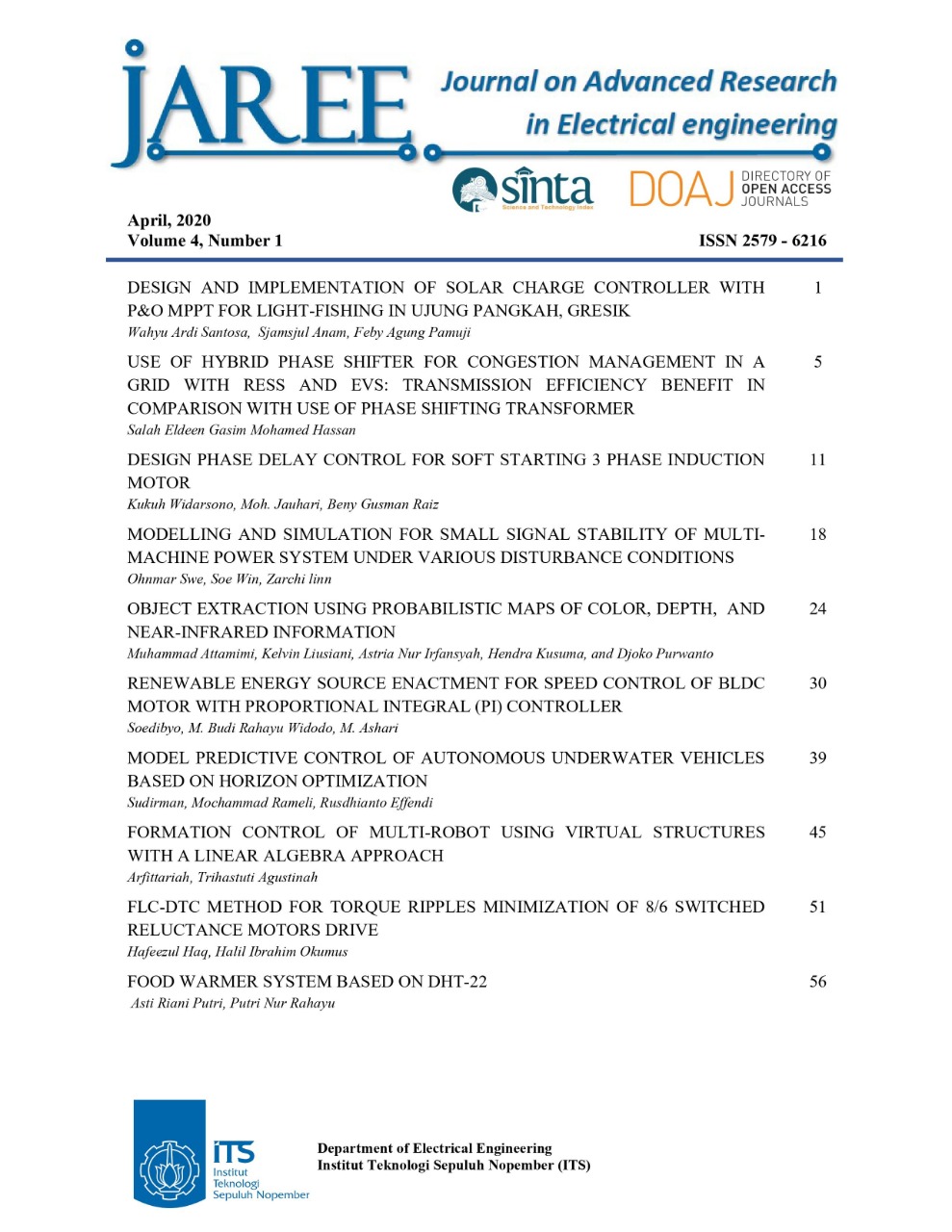
Model Predictive Control of Autonomous Underwater Vehicles Based on Horizon Optimization
DOI:
https://doi.org/10.12962/j25796216.v4.i1.109Abstrak
Heading control of Autonomous Underwater Vehicle (AUV) using Model Predictive Control (MPC) gives a good performance. Varying the length of the horizon provides a variety of performance. This paper is made in order to find out how many optimal horizons are needed to obtain the highest efficiency of energy use in AUV. Test results show a positive correlation between the length of the horizon and the amount of energy used. The optimal horizon obtained is then tested on several different trajectories.
Keywords: autonomous underwater vehicle, horizon optimizatoin, model predictive control.
Referensi
REFERENCES
Yan Z., Siu F.c. dan Jun W. (2012),"Underwater Vehicles Based on the Simplified Dual Neural Network". IEEE International Conference on Systems, Man, and Cybernetics, 14-17 Oktober 2012, COEX, Seoul, Korea.
Wang Luiping (2009),"Model Predictive Control System Design and Implementation Using MATLAB". Springer-Verlag London Limited.
Teong-Beng Koay and Mandar Chitre (2013), “Energy-efficient path planning for fully propelled Energy-efficient Path Planning for Fully Propelled”, Conference Publications at OCEANS - Bergen, MTS/IEEE
Louis Andrew Gonzalez (2004), “Design, Modelling And Control Of An Autonomous Underwater Vehicle”. Thesis at School of Electrical, Electronic and Computer Engineering, The University of Western Australia.
Daniel Steinberg, et.al. (2011),” Analysis of Propulsion Methods for Long-Range AUVs”. Issues in Technology Theory, Research, and Application. ScholarlyEditions.TM, Atlanta, Georgia
G Griffiths, et. al. (2008), "Energy Storage for Long Endurance AUVs", Publication at National Oceanography Centre.
Amir Rezaei dan Jeffrey B. Burl (2015)," Effects of Time Horizon on Model Predictive Control for Hybrid Electric Vehicles ". IFAC-PapersOnLine 48-15 (2015) 252–256.
Ting Gao, et. al. (2012), “Optimum Design of an AUV by Using Computational Fluid Dynamic Analysis”, Proceedings of 2012 International Conference on Mechanical Engineering and Material Science (MEMS 2012)
Petar Kormushev dan Darwin G. Caldwell (2013), "Improving the Energy Efficiency of Autonomous Underwater Vehicles by Learning to Model Disturbances", Intelligent Robots and Systems (IROS), IEEE/RSJ International Conference, 3-7 November 2013, Tokyo – Japan.
Peter Ridley, Julien Fontan dan Peter Corke (2003),"Submarine Dynamic Modeling". Australian Conference on Robotics & Automation, Brisbane, Australia.
Valerio De Carolis, David M. Lane, Keith E. Brown (2014)," Low-cost Energy Measurement and Estimation for Autonomous Underwater Vehicles", Proceedings of IEEE-MTS Oceans, Taipei, Taiwan.
##submission.downloads##
Diterbitkan
Terbitan
Bagian
Lisensi
Copyright
Submission of a manuscript implies that the submitted work has not been published before (except as part of a thesis or report, or abstract); that it is not under consideration for publication elsewhere; that its publication has been approved by all co-authors. If and when the manuscript is accepted for publication, the author(s) still hold the copyright and retain publishing rights without restrictions. Authors or others are allowed to multiply article as long as not for commercial purposes. For the new invention, authors are suggested to manage its patent before published. The license type is CC-BY-NC 4.0.
Disclaimer
No responsibility is assumed by publisher and co-publishers, nor by the editors for any injury and/or damage to persons or property as a result of any actual or alleged libelous statements, infringement of intellectual property or privacy rights, or products liability, whether resulting from negligence or otherwise, or from any use or operation of any ideas, instructions, procedures, products or methods contained in the material therein.