
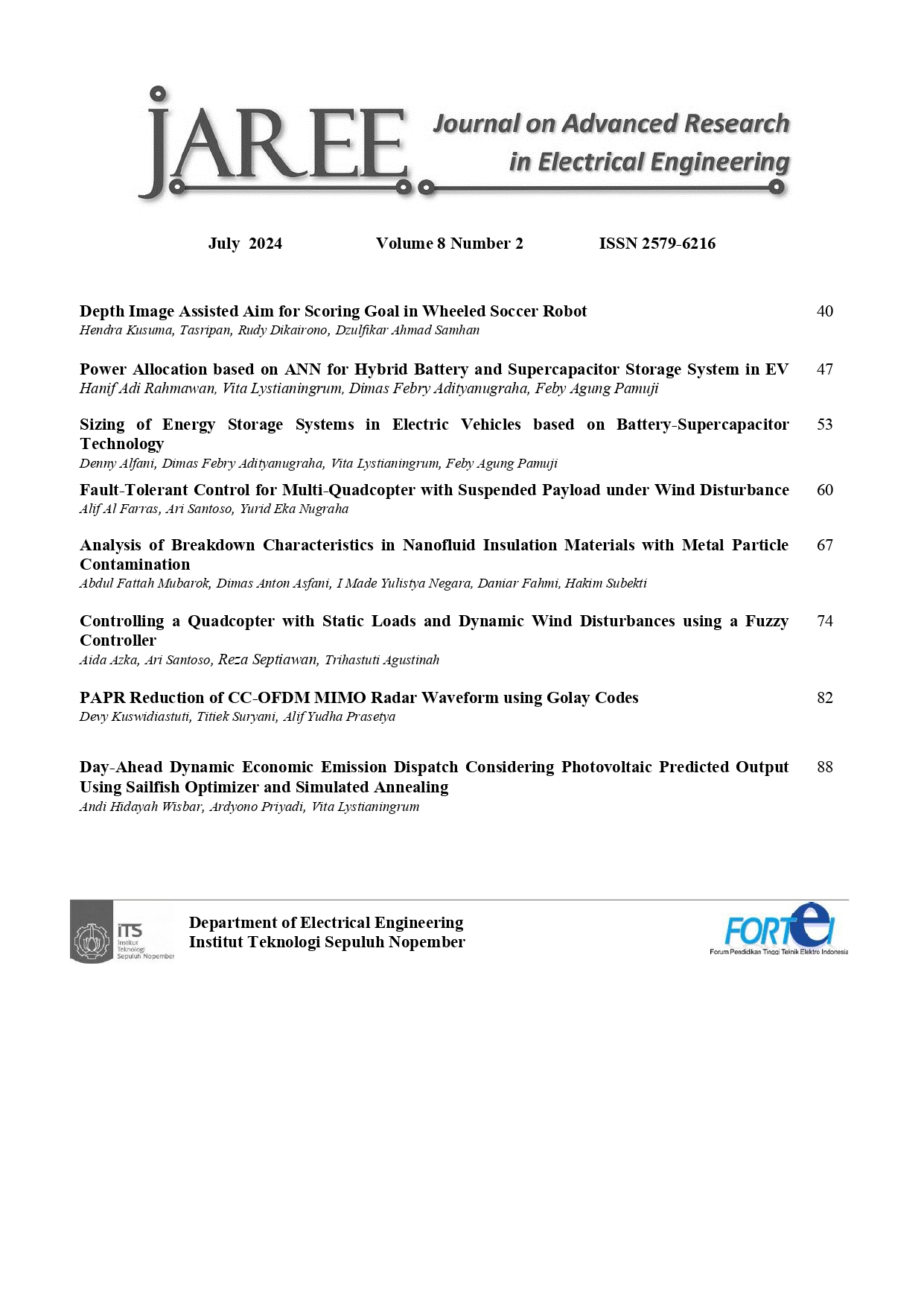
Fault-Tolerant Control for Multi-Quadcopter with Suspended Payload under Wind Disturbance
DOI:
https://doi.org/10.12962/jaree.v8i2.406Abstrak
Delivering payload with multiple quadcopters necessitates a reliable backup system. This research introduces a fault-tolerant design specifically for multi-drone payload transportation. The system employs formation control, ensuring the weight is evenly distributed among all functioning drones. This research tackles the challenge of reliable payload delivery with multi-drone systems. It proposes a new fault-tolerant control system specifically designed for this purpose. The system addresses a limitation in existing solutions by incorporating a simple PD controller alongside a fault-tolerant strategy. This approach allows the system to maintain operation even if a drone malfunctions. The paper further demonstrates the system's effectiveness through simulations. Results show the system's ability to maintain stability with minimal altitude loss (only 6.3cm) and rapid position reconfiguration (within 3.96 seconds) even under windy conditions. These findings highlight the potential of this fault-tolerant design to significantly improve multi-drone payload delivery, especially for missions requiring high levels of stability and redundancy.Referensi
Chen, W. C., Lin, C. L., Chen, Y. Y., & Cheng, H. H. (2023). Quadcopter Drone for Vision-Based Autonomous Target Following. Aerospace, 10(1), 82.
Wu, S., Li, R., Shi, Y., & Liu, Q. (2021). Vision-based target detection and tracking system for a quadcopter. IEEE Access, 9, 62043-62054.
Vong, C. H., Ryan, K., & Chung, H. (2021). Trajectory tracking control of quadcopters under tunnel effects. Mechatronics, 78, 102628.
Habibbayli, T. H. (2022). Formation of the quadcopter flight path under overland monitoring using neuro-fuzzy modeling methods. Mathematical machines and systems, 3, 97-107.
Sato, R., Tanaka, K., Ishida, H., Koguchi, S., Pauline Ramos Ramirez, J., Matsukura, H., & Ishida, H. (2020). Detection of gas drifting near the ground by drone hovering over: Using airflow generated by two connected quadcopters. Sensors, 20(5), 1397.
Dutta, A., Chanda, A., Das, K., Das, S. C., Dwibedi, A., Bose, A., & Das, S. (2020). Self-balancing multipurpose quadcopter for surveillance system. Int. J. Res. Appl. Sci. Eng. Technol, 8, 381-384.
Alsoliman, A., Rigoni, G., Callegaro, D., Levorato, M., Pinotti, C. M., & Conti, M. (2023). Intrusion detection framework for invasive fpv drones using video streaming characteristics. ACM Transactions on Cyber-Physical Systems, 7(2), 1-29.
Siddiqui, W. A., Srivastava, M. C., Krishnan, S., & Verma, V. (2024). Design and Fabrication of FPV Racing Drone. Journal of Mechanical and Construction Engineering (JMCE), 4(1), 1-8.
Hanover, D., Loquercio, A., Bauersfeld, L., Romero, A., Penicka, R., Song, Y., ... & Scaramuzza, D. (2024). Autonomous drone racing: A survey. IEEE Transactions on Robotics.
Li, B., Li, S., Wang, C., Fan, R., Shao, J., & Xie, G. (2021, October). Distributed Circle Formation Control for Quadrotors Based on Multi-agent Deep Reinforcement Learning. In 2021 China Automation Congress (CAC) (pp. 4750-4755). IEEE.
Nurjanah, S., Agustinah, T., & Fuad, M. (2022). Cooperative position-based formation-pursuit of moving targets by multi-uavs with collision avoidance. JAREE (Journal on Advanced Research in Electrical Engineering), 6(2).
Liu, H., Wang, Y., Lewis, F. L., & Valavanis, K. P. (2020). Robust formation tracking control for multiple quadrotors subject to switching topologies. IEEE Transactions on Control of Network Systems, 7(3), 1319-1329.
Chen, G., Peng, P., Zhang, P., & Dong, W. (2023). Risk-aware trajectory sampling for quadrotor obstacle avoidance in dynamic environments. IEEE Transactions on Industrial Electronics.
Çorbacı, F. K., & Doğan, Y. E. (2023). An Approach to Preliminary Design of a Quadrotor Cargo UAV. International Journal of Aviation Science and Technology, 4(02), 63-74.
Saiella, L., Cristofaro, A., Ferro, M., & Vendittelli, M. (2021, June). Fault-tolerant formation control of a team of quadrotors with a suspended payload. In 2021 International Conference on Unmanned Aircraft Systems (ICUAS) (pp. 1-9). IEEE.
Rinaldi, M., Primatesta, S., & Guglieri, G. (2023). A comparative study for control of quadrotor UAVs. Applied Sciences, 13(6), 3464.
Allison, S., Bai, H., & Jayaraman, B. (2020). Wind estimation using quadcopter motion: A machine learning approach. Aerospace Science and Technology, 98, 105699.
Dhiman, K. K., Kothari, M., & Abhishek, A. (2020). Autonomous load control and transportation using multiple quadrotors. Journal of Aerospace Information Systems, 17(8), 417-435.
Klausen, K., Meissen, C., Fossen, T. I., Arcak, M., & Johansen, T. A. (2018). Cooperative control for multirotors transporting an unknown suspended load under environmental disturbances. IEEE Transactions on Control Systems Technology, 28(2), 653-660.
##submission.downloads##
##submission.additionalFiles##
Diterbitkan
Terbitan
Bagian
Lisensi
Copyright
Submission of a manuscript implies that the submitted work has not been published before (except as part of a thesis or report, or abstract); that it is not under consideration for publication elsewhere; that its publication has been approved by all co-authors. If and when the manuscript is accepted for publication, the author(s) still hold the copyright and retain publishing rights without restrictions. Authors or others are allowed to multiply article as long as not for commercial purposes. For the new invention, authors are suggested to manage its patent before published. The license type is CC-BY-NC 4.0.
Disclaimer
No responsibility is assumed by publisher and co-publishers, nor by the editors for any injury and/or damage to persons or property as a result of any actual or alleged libelous statements, infringement of intellectual property or privacy rights, or products liability, whether resulting from negligence or otherwise, or from any use or operation of any ideas, instructions, procedures, products or methods contained in the material therein.